

Contents
- 1 Can Damp Polyferric Sulfate (PFS) Still Be Used? A Complete Water Treatment Guide
Can Damp Polyferric Sulfate (PFS) Still Be Used? A Complete Water Treatment Guide
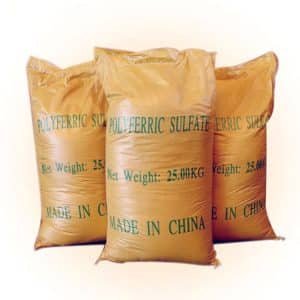
Polyferric Sulfate (PFS) is one of the most widely used inorganic polymer coagulants for industrial wastewater treatment, municipal sewage purification, and even some drinking water pre-treatment. WHO Guidelines for Drinking-water Quality
But here’s a common challenge faced by plant managers and technicians: PFS is hygroscopic, meaning it easily absorbs moisture during storage or transport. This often leads to lumping or clumping—raising the question:
???? Can damp Polyferric Sulfate (PFS) still be used effectively in water treatment?
The short answer: sometimes yes, sometimes no. In this guide, we explain when damp PFS can still deliver results, when it must be replaced, and how to prevent moisture damage in the first place.
When Damp Polyferric Sulfate (PFS) Is Still Safe to Use
Not all damp Poly Ferric Sulfate is useless. If clumping is the only issue and the product hasn’t deteriorated, it can often be salvaged.
1. Lumpy but No Oxidation or Discoloration
Fresh PFS should be light yellow or pale brown. If moisture only causes lumping—without turning dark yellow, red, or black—the ferric ions remain active.
How to reuse:
-
Crush lumps into fine particles (<2mm) before dissolving.
-
Stir vigorously when preparing the solution for full dissolution.
-
Slightly increase solution concentration (e.g., from 15% to 20%) to offset minor activity loss.
2. Short-Term Moisture Exposure Only
If Poly Ferric Sulfate packaging is damaged for less than 7 days, and the product has not been exposed to high heat (>80℃) or oxidizers (e.g., chlorine), the activity loss is usually <5%.
Best use cases:
-
Industrial wastewater (printing, dyeing, steel, paper).
-
Low-standard effluent turbidity removal.
⚠️ Avoid using damp PFS in drinking water treatment or heavy metal removal processes.
When to Stop Using Damp Poly Ferric Sulfate
Using deteriorated PFS can cause poor flocculation, higher chemical costs, inconsistent effluent, and even equipment damage. Stop using damp PFS if you see:
1. Severe Oxidation or Discoloration
If PFS turns bright yellow, reddish-brown, or rust-colored, it indicates oxidation.
-
Risk: Flocculation power may drop by 30–50%.
-
Result: Slow sedimentation, cloudy effluent, higher chemical demand.
2. Expired + Damp
-
Shelf life: 6 months for solid PFS, 3–6 months for liquid PFS.
-
If damp and past expiration, ferric complexes will have decomposed.
-
Risk: Secondary pollution, especially dangerous in drinking water treatment.
3. Poor Dissolution Stability
If, after dissolving, the solution shows heavy sediment, reddish layers, or floating particles, hydrolysis stability is gone.
-
Impact: Pump and filter blockages, uneven coagulation, inconsistent effluent quality.
Pro Tips: Using Damp PFS Safely & Preventing Moisture
Even if PFS is reusable, follow these practices to maximize performance.
Pre-Use Preparation for Damp PFS
-
Crush thoroughly: Reduces dissolution time by ~40%.
-
Prepare a mother liquor: Dissolve in 10–30% high-concentration solution first, then dilute to 1–3%.
-
Run a test: Treat a 1L wastewater sample and check:
-
Floc formation speed (within 1–2 minutes).
-
Sedimentation (<15 minutes).
-
Effluent turbidity (<5 NTU).
-
If results fail, increase dosage or switch to fresh PFS.
Storage Tips to Prevent Dampness
-
Location: Dry, cool warehouse (<75% humidity, <80℃).
-
包装 Keep sealed; use clips + moisture-proof buckets for opened bags.
-
Moisture absorbers: Add silica gel or calcium chloride packs (replace every 2 months).
-
Liquid PFS: Store in corrosion-resistant containers, avoid freezing or direct sunlight.
Final Takeaway: Effectiveness First, Savings Second
-
Slightly damp PFS (only lumpy, no discoloration) can be reused safely with proper crushing, testing, and dosage adjustment.
-
Heavily oxidized, expired, or unstable PFS should be discarded. The risks of poor treatment, fines, or equipment damage far outweigh the savings.
At WaterCareChem, we help clients choose, test, and apply PFS efficiently to maximize results and minimize waste.
???? Need expert guidance or fresh, high-quality Poly ferric Sulfate? Contact WaterCareChem today for technical support and bulk supply.
Last Updated on 2025-09-26 by system
 English
  Spanish
  Portuguese
  German
  French
  Italian
  Russian
  Korean
  Japanese
  Arabic
  Thai
Thai  Turkish
  Dutch
Dutch  Vietnamese
  Indonesian
  Chinese